When Effingham County selected the City of Springfield as its permanent county seat in 1799, it found more than just a central location. Railroad and sawmill industries thrived in the county, and in the coming years Springfield became home to local commerce, entertainment, public service, churches and hundreds of homeowners. Springfield emerged as a dynamic city among its sister cities in the County.
Present day structures have blended into Springfield’s historical buildings preserving our town’s feeling of yesteryear. Amid gracious Folk Victorian homes you’ll find thriving businesses and a strong sense of community. No matter what change has brought to our city over the years, Springfield has remained “The Heart of Effingham.”
Our History
The City of Springfield found its early roots amidst a state-appointed commission’s designation of a centrally located county seat and Courthouse 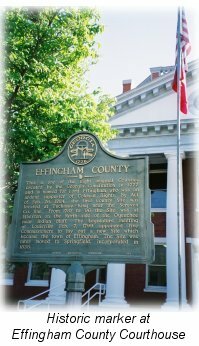 square in 1799. Effingham County had claimed three different county seats before the turn of the century, but with the new establishment of Springfield as the county’s hub, Effingham had finally found its “heart.”
A Town with a Plan
Following the traditional “square town plan” of many towns throughout the South, Springfield spread its branches from the Courthouse square and grew into a town filled with houses, community establishments and other public buildings. The arrival of the railroad and the George M. Brinson Sawmill in the early 1900s brought thriving business to Springfield along with almost a 500 percent increase in population. The rich architecture and history of our town suffered greatly as the result of a series of fires during the late 1800s through the 1960s. While Springfield’s heritage remained strong, we lost many of our city’s architectural treasures to the ravages of these fires.
One of the “jewels” that survived is the site of our original Courthouse and the Old Jail. Following Greek Classical design, the Courthouse was built and designed by Savannah architect Hyman W. Witcover. As our county grew, this original building also grew to house the many public and government services needed to accommodate our county’s changing needs.
A Sense of Style
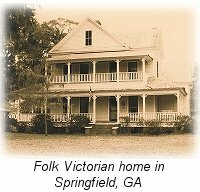 Along with that growth emerged a change in home styles. As numerous new homes were constructed in 1910, the Bungalow or Folk Victorian style of building became prevalent in Springfield. These homes were fashioned for comfort of living in Springfield’s warm coastal environment. Raised foundations reduced rising heat from the ground and provided ventilation. Floor plans made the most of cool evening breezes, and roof lines minimized the unrelenting rays of the hot Georgia sun. Spacious porches added to the comfortable style of living enjoyed by Springfield residents and served as perfect locations for relaxing afternoons and neighborly visits.
Growing and Building
A growing population meant a growing need for community services including an armory, churches and various businesses. Although Springfield currently serves as home to seven churches, two church buildings served the community in the early 1900s. The Baptist Church and the Methodist Episcopal Church met in their original sanctuaries until fires and growth demanded that they build new structures. The Lutheran Church, Springfield’s third oldest congregation, came along in 1909 and still meets in its original sanctuary.
Getting Down to Business
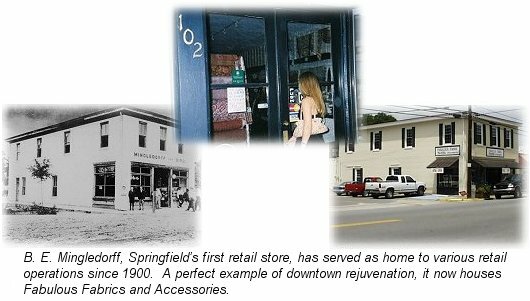
Business began booming in Springfield’s earliest days. What started with one retail store operated by B. E. Mingledorff in 1900 grew into multiple businesses to fill the needs of Springfield’s rapidly growing population. J. B. Simmons Sale and Retail Groceries, a drug store, a meat market, the Exchange Bank of Springfield, and Mingledorff and Bird Hat and Clothing Store all opened their 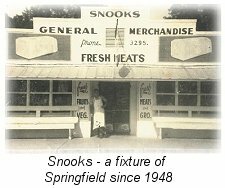 doors to local patrons offering a variety of materials and services.
Family-owned businesses have served as a long-standing tradition of Springfield’s close-knit business community. Later Springfield business landmarks included the Mars Theatre, Kight Ford Dealership, barbershops, an old-fashioned drug store complete with soda fountain, and Snooks IGA, which has served as Springfield’s friendly, family-owned grocery since 1948. Although our business community has evolved over the years in response to the City’s needs and our county’s growth, it has remained an integral part of life in Springfield.
A Season of Change
Over the years, Springfield has weathered many seasons of change. Springfield strives to effectively and creatively blend its past with its future. With the construction of the Highway 21 Bypass, what was once a main county thoroughfare through the streets of Springfield diverted thousands of travelers from its Main Street. The City of Springfield capitalized on this new development by focusing our efforts on rejuvenating the hometown feel of our businesses, homes and services. The result has been a renewed interest in the reason so many of us are proud to call Springfield home – a feeling of family, a long history of traditions and a strong sense of hometown pride.